Call us: +91-958-687-8283 Mail us: gizapumps@gmail.com


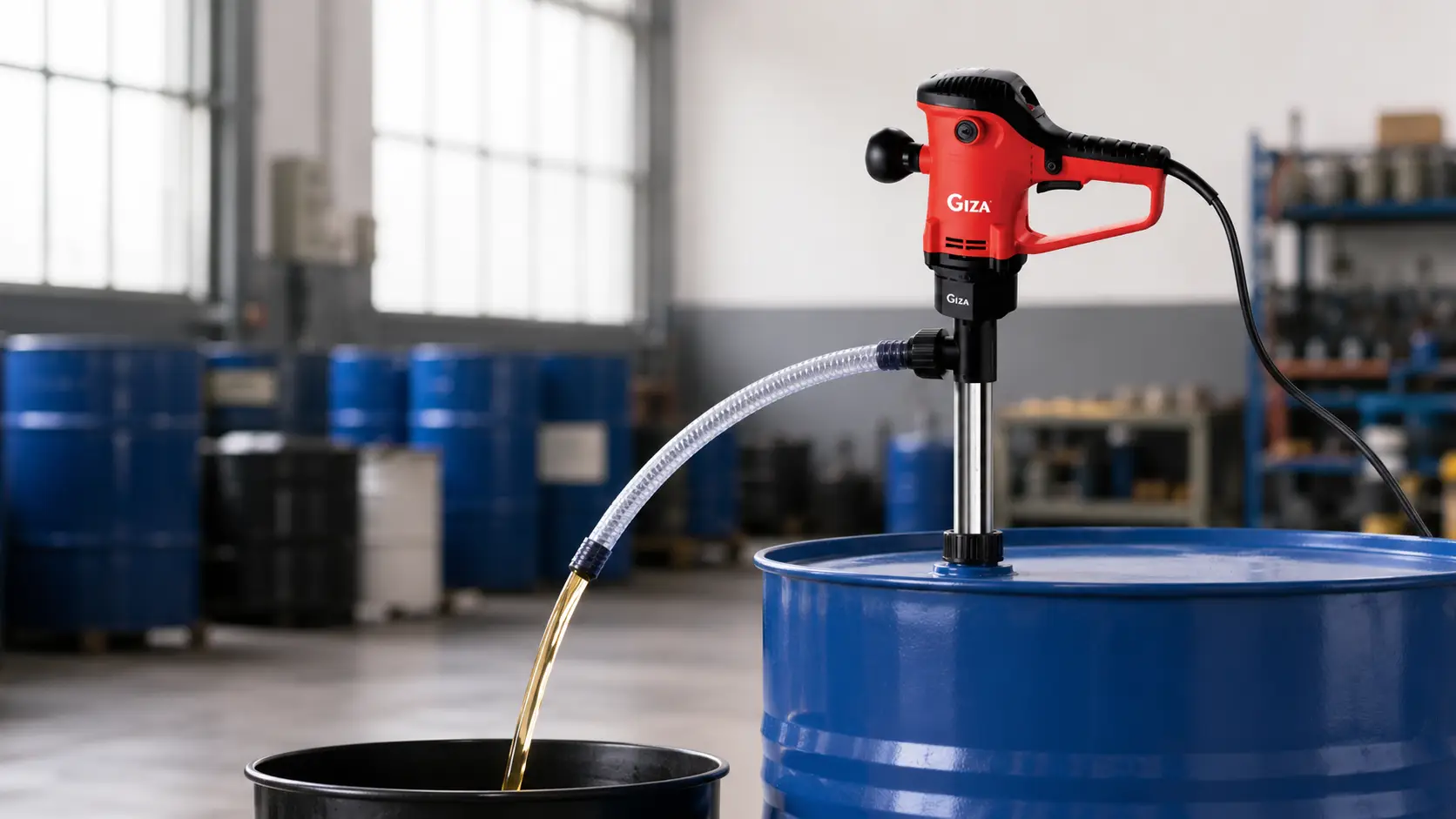
Tilt a heavy drum to pour out oil, and you already know what happens. A few litres end up on the floor. If the liquid is corrosive, that's not just messy, it's a real problem. That's the whole reason an Electric Drum Pump exists in the first place. It takes the physical part out of the job. Liquid moves through a hose instead of someone's arms and back.
In Indian factories and workshops, this has quietly become a go-to tool whenever a Liquid Transfer Pump is needed for everyday work. Some days it's emptying a full container in one go. Other days it's just a quick top-up. Either way, less guesswork than the old tilt-and-pour method.
So what exactly does this thing do, why does it matter, what types exist, and where does it actually get used? Let's get into it.
An Electric Drum Pump is, at its core, a motor-driven unit. It pulls liquid out of a drum or barrel and pushes it somewhere else through a hose or nozzle. That's really the whole idea.
A manual Drum Pump needs someone cranking a handle non-stop. This one doesn't. The motor does the work on its own, and the flow just keeps going. It's commonly used as a Drum Pump for Oil. Swap the tube material and it works fine as a Drum Pump for Chemicals too.
Most models pair a stainless steel or polypropylene tube with a sealed motor housing sitting on top. Why does that matter? Because it keeps electrical parts away from whatever liquid is being handled, which is important once you're dealing with something sticky, thick, or a bit aggressive. No cranking also means the person running it isn't wiped out by the end of a long shift.
Pouring by hand isn't just slow. It's risky. Spills happen. Fumes get inhaled. Workers end up standing closer to hazardous liquids than they probably should. A solid Fluid Transfer Pump cuts that risk down quite a bit. It saves time, it keeps the floor cleaner, and it puts some distance between the person and whatever's being pumped.
Doesn't matter whether the setup runs on a Barrel Pump or a fully electric unit. The point stays the same — move liquid safely, without burning half the shift doing it.
There's a production angle too. Slow liquid handling drags everything else down. A pump that just keeps working avoids that bottleneck, and wastes less liquid than manual pouring generally does.
Not every job calls for the same build. Most manufacturers keep a handful of options on hand:
Line them all up and you get a fairly wide Industrial Drum Pump lineup — one that covers almost anything a plant might need to move around.
Here are the features to consider for an electric drum pump:
Where does someone actually source one, and who's worth buying from? That's usually the first question once a business decides it needs one. Most established Industrial Pump Manufacturer companies in India keep several models ready side by side, along with manual and air-driven options for anyone who wants to compare first.
A buyer typically has a choice between the standard Electric Drum Pump or a Stainless Steel Drum Pump, depending on what's being handled day to day.
For chemical-heavy operations, a dedicated Chemical Transfer Pump is usually the safer pick over a general-purpose unit.
It's also worth asking whether the supplier carries a proper Oil Transfer Pump line, since petroleum liquids don't behave quite like chemicals do. A manufacturer that tests every unit before shipping, rather than just pushing a sale, tends to save the buyer trouble later on.
Here are the benefits of electric drum pump:
Small workshops use these. So do massive processing plants. The scale changes, the need doesn't:
|
TRIVIA: Rotary drum pumps aren't new. Early hand-cranked versions were moving kerosene out of storage barrels more than a century back. |
| Aspect | Electric Drum Pump | Manual Drum Pump | Air-Operated Barrel Pump |
|---|---|---|---|
| Power Source | Electric motor | Manual hand action | Compressed air |
| Operator Effort | Minimal | High | Low |
| Flow Consistency | Continuous and steady | Depends on operator | Steady, air-dependent |
| Best Suited For | Regular, high-volume transfer | Occasional, small-batch use | Flammable liquid environments |
| Maintenance Need | Low to moderate | Low | Moderate |
|
DID YOU KNOW: Manually tilting and pouring liquid from heavy drums all day is physically demanding work — an electric unit takes over nearly all of that manual effort. |
Skip the guesswork here — a bit of homework upfront saves trouble later:
|
FACT: Stainless steel resists a wide range of industrial acids and chemicals, though not all — compatibility still needs checking case by case. That's why a Stainless Steel Drum Pump is a common pick in chemical-heavy settings, alongside PP models for tougher fluids. |
Swastik Enterprise Giza Pumps, a leading Manufacturer of industrial pumping solutions in India, was established in 1999 and possesses more than 27+ years of experience. The company specializes in manufacturing a high quality range of rotary barrel pumps, drum pumps and liquid transfer pumps that help industries move fluids smoothly, securely and efficiently. Made of durable construction, Giza Pumps provide years of reliable, leak free service. It serves chemical, automotive, manufacturing and oil handling industries. Emphasized on innovation, quality, customer satisfaction and durability, the company provides efficient energy and lasting pumping solutions to simplify the transfer process of industrial liquid.
Ans: Depends mostly on the tube material. Stainless steel units handle many acids and solvents well, though not all — always check compatibility for stronger types. Polypropylene works better for certain corrosive liquids. Standard models suit oils, fuels, and lubricants. Match the material to the liquid, or it won't hold up long.
Ans: Manual means someone's cranking a handle the whole time, and that gets old fast on longer jobs. Electric just runs the motor and keeps going by itself. Flow stays steady without anyone pushing it along. If it's a daily task or high volume, electric wins out — manual just can't keep pace.
Ans: Depends on the model. Standard electric units aren't built for flammable liquids — any spark near fuel or solvent vapor is a genuine hazard. Flame-proof or explosion-proof variants use sealed, spark-resistant motor housings designed for hazardous locations. Always confirm the safety certification before using any pump around flammable liquids or vapors.
Ans: Honestly, it comes down to build quality more than anything. A decent unit with corrosion-resistant parts can run for years, no real drama involved. Cheap materials are a different story. Same with the wrong match for an aggressive liquid — wears out fast. Clean it, store it right, don't push past its rated limit.
Ans: Not a great idea. Most people find that out the hard way, unfortunately. Oils and chemicals just don't react the same with pump materials. Something fine for lubricants can start corroding inside a Chemical Drum Pump within weeks. Safer bet? Keep separate units, or at least swap tubes and nozzles between uses.
Ans: Start with the liquid, match the wetted material to it, don't skip that step. Then look at flow rate against what's actually transferred daily, not just the number on the spec sheet. Get a compatibility chart from the manufacturer if you can. A demo helps too. Ask about support after the sale.
Honestly, an Electric Drum Pump stopped being optional a while back for anyone handling liquids at scale. It's just part of running things safely now. Pick the right Drum Pump for whatever liquid you're dealing with. Buy from a manufacturer that actually stands behind its work. Do that, and the pump usually pays for itself over years, not months.
One last thing before wrapping up — compare a couple of models. Check the tube material against your liquid. Ask what happens after the sale if something goes wrong. None of this takes long, and it saves both time and money down the road.
Looking for a reliable Electric Drum Pump for your industry? Get in touch with a trusted Industrial Pump Manufacturer such as Giza Pump today for the right solution. Contact Us Now!
Giza pumps are easy to use, quick to install, and designed to deliver reliable performance in everyday use.