Call us: +91-958-687-8283 Mail us: gizapumps@gmail.com


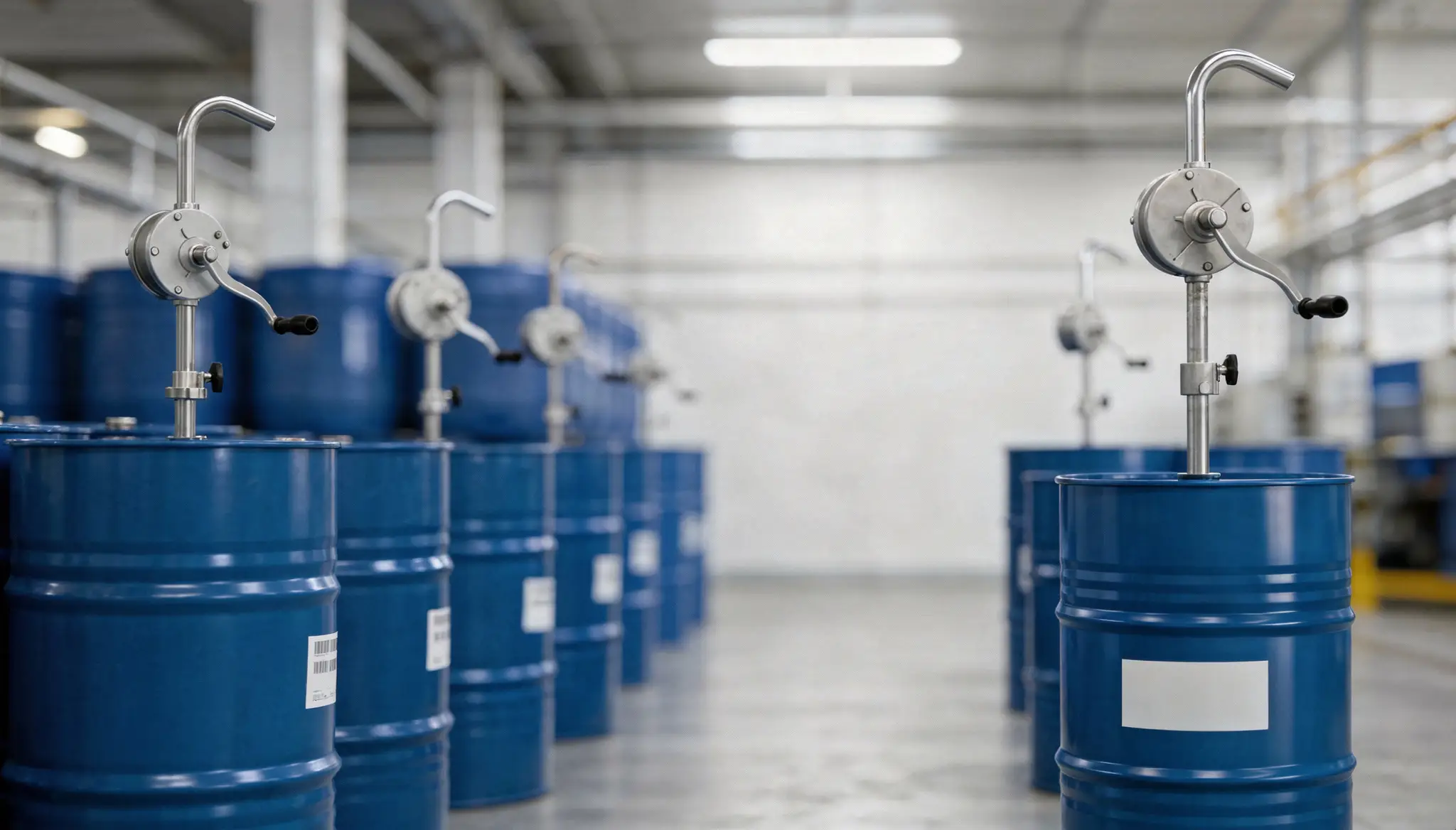
Walk through most chemical or food processing plants in India and you will spot the same scene—a worker tilting a 200-liter drum at an awkward angle, trying to coax the last of a thick fluid into a vessel below. It is slow, physically demanding, and wasteful. And yet, it is accepted as routine.
That acceptance is costing plants more than they realise. Incomplete drum emptying means raw material losses add up quietly over months. Spillage creates cleaning time, safety incidents, and in regulated sectors, compliance headaches. Manual handling at drum level is also one of the more common causes of back strain on the production floor — a cost that never shows up on a maintenance sheet but lands squarely on HR and insurance budgets.
The fix does not require a capital project. In most cases, a properly specified Barrel Pump — fitted to the drum, connected to an outlet, and operated by a single worker — changes the entire picture.
The mistake is almost always the same: selecting a pump based on price rather than fluid properties.
A plant handling edible oils, pharmaceutical solvents, and industrial adhesives needs very different specifications. The wrong seal material will swell and fail within weeks. A tube that is too short leaves a product at the bottom. A motor that draws too slowly creates excessive shear on delicate emulsions. These are not theoretical concerns — they are the exact reasons why maintenance teams across India end up replacing pumps far too often.
The most important decision is material grade. SS Rotary Barrel Pump 316L is the specification that keeps coming up in plants where chemical compatibility is a hard requirement.
The molybdenum content in 316L provides a degree of pitting resistance that standard 304 simply cannot match when the process fluid contains even trace amounts of chlorides, phosphoric compounds, or strong organic acids.
Unlike centrifugal pumps, which depend on fluid velocity to generate pressure, a rotary pump works by physically trapping fluid inside a rotor cavity and pushing it forward through the discharge path. This distinction matters enormously when viscosity increases.
A centrifugal design handling a fluid above 500 cP begins to lose efficiency rapidly. Flow drops, energy consumption rises, and the pump may run dry before the drum is empty. A rotary design handles the same fluid with barely any adjustment. That mechanical advantage is exactly why the oil barrel pump has become the standard in lubrication workshops and petroleum blending facilities — the fluid properties that challenge other designs do not cause the same trouble here.
For industrial buyers sourcing SS Rotary Barrel Pumps In India, this distinction between pump types is worth pressing suppliers on. Not every pump sold as a barrel pump is a rotary design, and the performance difference in real plant conditions is not marginal.
Any reputable SS Barrel Pump will meet basic dimensional and pressure standards. Beyond those, the points below separate a unit that runs reliably for years from one that causes repeated headaches:
The SS Rotary Barrel Pumps range available through established dealers covers a wider range of industries than most buyers initially expect:
| Parameter | SS 304 Grade | SS 316L Grade |
|---|---|---|
| Material Composition | 18% Cr, 8% Ni | 16% Cr, 10% Ni, 2–3% Mo |
| Corrosion Resistance | Good — general use | Excellent — superior chemical resistance |
| Typical Fluid Suitability | Water, mild acids, food | Solvents, acids, agrochemicals |
| Max Operating Temp | Up to 120°C | Up to 150°C |
| Surface Finish Option | Brushed / polished | Electropolished, cGMP-ready |
| Common Industry Use | Food, pharma, water | Chemical processing, pharmaceuticals, agrochemicals |
| Regulatory Compliance | FDA-grade gaskets | CE, NSF, ATEX-compatible |
Not all SS Barrel Pump Manufacturers are comparable. The gap between a certified manufacturer with documented quality systems and an assembler buying generic components is significant — and usually invisible until something fails in service.
The strongest SS Rotary Barrel Pump Manufacturers In India combine manufacturing depth with genuine application knowledge. They ask about your fluid before quoting a product. That habit, more than any certificate displayed on a wall, is usually the clearest indicator of a supplier worth building a long-term relationship with.
“Swastik Enterprise Giza Pumps, an Indian-based company, specialises in manufacturing industrial pumping solutions and it has over 27+ years of experience in the industry. It is a firm that deals with the manufacture of high-quality rotary barrel pumps, drum pumps, and other liquid-transfer pumps that are safe, smooth and efficient in handling fluids. These pumps are also produced under robust materials and engineering skills to guarantee long services, dependability and leak-free operation in harsh environments. Auto industries, chemical industries, manufacturing industries, and oil handling are among the industries that have Giza Pumps.
The company believes in innovation, adherence to quality, and customer-orientated service to provide customers with reliable products. It has a mission of offering pumping solutions that are long-lasting and energy-saving and that facilitate ease of transfer of liquids and also enhance efficiency in the operations of the contemporary industries.”
Ans: 316L contains 2–3% molybdenum, which 304 lacks entirely. That difference gives it far stronger resistance to chloride-heavy and acidic fluids — the exact environments where 304 tends to pit and fail early.
Ans: Chemical plants, pharmaceutical manufacturers, food processors, and paint producers are the heaviest users. Any facility pulling thick or reactive fluids from drums regularly will have at least one SS Rotary Barrel Pumps unit on the floor.
Ans: Yes — that is exactly where a rotary design earns its keep. Unlike centrifugal pumps, which lose efficiency fast above 500 cP, the rotary mechanism maintains consistent flow even through dense, slow-moving fluids without straining the motor.
Ans: Start with your fluid's chemical family. PTFE handles most acids and solvents reliably. Viton suits petroleum-based fluids and higher temperatures. Any reputable SS Barrel Pump Manufacturers should guide you through compatibility before confirming a specification.
Ans: Always request mill certificates for wetted components, a hydrostatic test report per unit, and seal material data sheets. These three documents tell you quickly whether a barrel pump supplier is serious about quality or just moving stock.
Ans: Largely the same design, tuned differently. An oil barrel pump typically runs at lower shaft speeds with wider rotor clearances to handle petroleum viscosity without heat build-up — the core rotary principle stays identical, the calibration changes.
Fluid transfer at drum level looks straightforward from a distance. In practice, it is one of the more consequential equipment decisions a plant engineering team makes — because the effects of a wrong choice play out slowly, through recurring maintenance calls, product losses, and operator injuries rather than a single obvious failure.
A well-chosen SS Rotary Barrel Pump Manufacturers in India partnership, with units matched carefully to the fluid, environment, and operating cycle, quietly eliminates each of those problems. The investment is modest. The operational return, measured honestly over two or three years, rarely is.
|
Ready to find the right specification for your application? Speak with verified SS Rotary Barrel Pumps Dealers in India today — get material grade confirmation, application review, and availability in one conversation. Contact Our Team Today |
Giza pumps are easy to use, quick to install, and designed to deliver reliable performance in everyday use.