Call us: +91-958-687-8283 Mail us: gizapumps@gmail.com


When considering an investment in rotary barrel pumps, it is essential to make the right choice. For more information, you can go through the following blog:
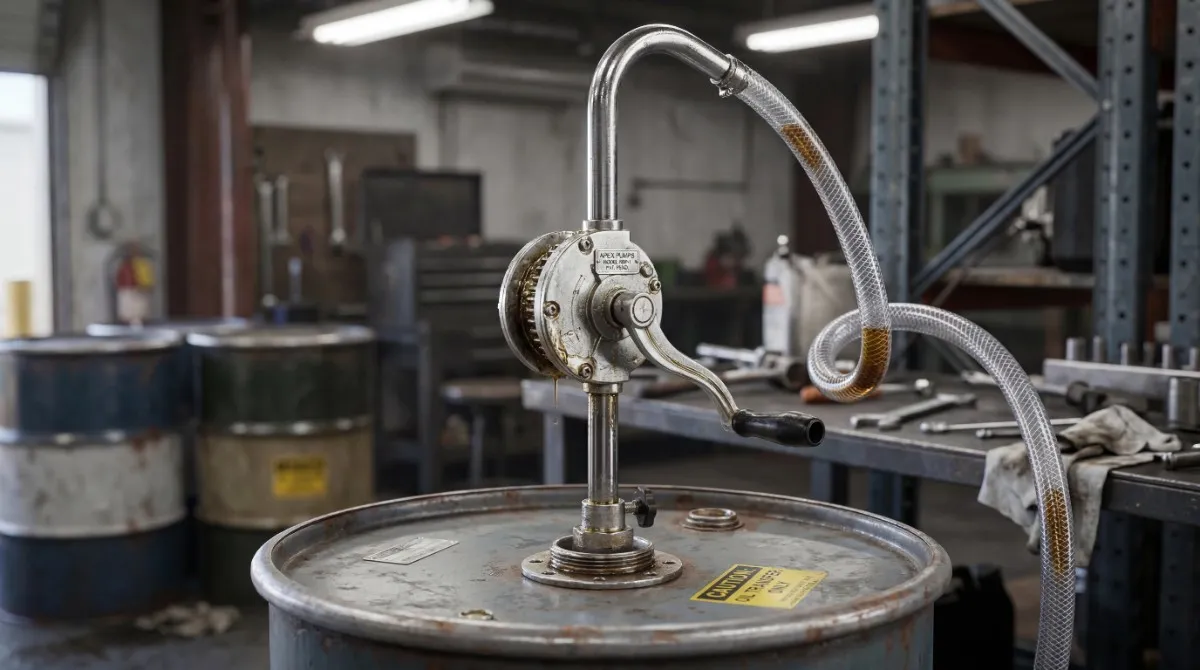
Rotary barrel pumps are designed to transfer liquids, such as oil, fuel, and chemicals, from drums to containers. These pumps also help reduce manual labour in carrying heavy containers.
People choose the Rotary Drum Pump to maintain the flow rate requirement and transfer various types of liquids like kerosene, light chemicals, etc.
Did you know? “16th Century Vane Technology: The concept of the sliding vane pump, a common mechanism for rotary barrel pumps, was described in 1588 by Italian engineer Agostino Ramelli in his book Le diverse et artificiose machine del capitano Agostino Ramelli.”
Drum pumps—These types of pumps often require a power source and compressed air, which make them ideal for large-scale industries where continuous liquid transfers work. They can also be manual or electric.
The following table compares Rotary Barrel Pumps and drum pumps.
| Feature | Rotary Barrel Pump | Drum Pump |
|---|---|---|
| Basic Definition | A manual pump with a rotating handle used to transfer liquids from barrels or drums. | A general category of pumps designed to move liquids from containers. |
| Operation Method | Operated by hand crank (rotary mechanism). | Can be manual, electric, pneumatic, or battery-powered. |
| Power Source | Human power (hand rotation). | Electric motor, air motor, battery, or manual depending on model. |
| Flow Rate | Low to moderate flow rate. | Moderate to high flow rate depending on pump type. |
| Applications | Commonly used for oils, diesel, kerosene, and light chemicals. | Used for chemicals, acids, solvents, oils, food liquids, and hazardous fluids. |
| Efficiency | Less efficient for large volumes. | More efficient for transferring large quantities. |
| Cost | Lower cost because it is simple and manual. | Higher cost due to motors or advanced materials. |
| Maintenance | Simple maintenance. | May require motor maintenance and seal checks. |
| Typical Use | Small workshops, farms, garages. | Industrial plants, chemical processing, laboratories. |
| Design Complexity | Simple mechanical design. | More complex design with motor and pump tube. |
Here are some of the applications of rotary barrel pumps:
For all the above-mentioned industries, rotary drum pumps are used to maintain smooth operations without any major problems.
Here is another blog related to drum pumps you might want to read:
The following table talks about the technical specifications of rotary barrel pumps.
| Specifications | Description |
|---|---|
| Pump Type | Manual Rotary Barrel Pump |
| Operating Method | Hand-operated rotary crank |
| Flow Rate | 18 – 70 L/min (depending on model) |
| Discharge per Rotation | ~0.3 – 1 litre per revolution |
| Suction Lift | Up to 1.5 – 2 m |
| Delivery Head / Lift | Up to 5 – 6 m |
| Inlet Diameter | 25 – 32 mm (1" – 1¼") |
| Outlet Diameter | 25 – 32 mm (1" – 1¼") |
| Suction Tube Length | 355 – 1300 mm (adjustable or telescopic) |
| Mounting Thread | 2" drum adaptor / bung fitting |
| Pump Body Material | Cast Iron, Stainless Steel (SS304/SS316), Aluminum or Polypropylene |
| Rotor / Vane Material | Steel, PTFE, Graphite, or Teflon vanes |
| Seal Material | NBR, PTFE, Butyl rubber, or Viton |
| Compatible Drum Size | 20 L – 205 L (5–55 gallon drums) |
| Pump Weight | Approx. 2 – 7 kg depending on material and design |
| Operating Temperature | -40°C to 50°C (typical range) |
| Suitable Liquids | Diesel, kerosene, lubricating oil, engine oil, hydraulic oil, light chemicals |
Here are the most asked questions related to rotary barrel pumps.
Giza will be known for the reliable and efficient work done by the rotary barrel pumps in the future, as they ensure durability and stability while working.
Here are some of the factors that need to be considered while selecting a rotary barrel pump manufacturer:
Drum Pump is another name for the rotary barrel pump.
Stainless Steel, Polypropylene (PP), PVDF, and Cast Iron (CI) are the materials of construction that were used for making a rotary drum pump.
Manual, Electric Motor & Air are the common types of pumps.
Oils, diesel, kerosene, lubricants, solvents, etc., are the liquids that are used to transfer from the drum pump rotary.
Here are some of the reasons:
Here is another blog, you might be interested to know more.
Advantages of Using Air Operated Barrel Pumps in Hazardous Environments
Here are some of the features:
Barrel Pump Rotary work requires less maintenance, has an efficient work structure, is easily portable, and can be installed anywhere.
Did you know? “Ancient Roots: While modern rotary pumps are refined, their basic concept is related to the Archimedean screw, which dates back to 200 BC, where a spiral was turned by hand to transport water.”
Giza is the best Rotary Barrel Pump Manufacturer in India. They provide a corrosion- and leak-free design to ensure high-performance, accurate, and stable flow. They ensure durability and stability and are effective in any harsh environment.
The right choice for better future performance is ensured by Giza, which is perfect for a rotary barrel pump. The brand also offers siphon pumps, cast-iron barrel pumps, air-operated barrel pumps, and much more.
Giza pumps are easy to use, quick to install, and designed to deliver reliable performance in everyday use.